Dell Technologies
A global rethink of how sellers quote and close infrastructure upgrade deals. I led the design of a proof of concept that brought key selling tools together in a unified platform experience and shaped a new strategic direction. The work earned VP-level executive buy-in and initiated global delivery.
Enterprise SaaS
AI-Enabled
Proof of Concept
Web App
Product Strategy

Context
The company had strong and growing demand for infrastructure upgrade deals, but the process of handling them was fragmented and impossible to scale and included 20+ different disconnected tools with inconsistent design.
I focussed on connecting the most important tools inside the sellers workflow:
Live Optics — asseses current customer infrastructure hardware and translates into data.
PowerSizer — sizes a solution based on customer requirements and current infrastructure data.
Dell Solutions Configurator — configures a final hardware solution and generates a quote.
Principal Product Designer
Team of 3 People
3 Weeks
3 Tools
Cross-Functional Collaboration

Problem
Disconnected tool across global selling flow
Each handoff between tools required manual data re-entry, specialist knowledge, and coordination across multiple teams.
Process heavily depends on two way interaction
Buyers had almost no ability to self-serve. Every step required involving a company representative, which created delays and friction.
Users give up on using tools due to complexity
Based on user interviews I defined that some users barely utilise tools because of their complexity so they can do calculations and sizing faster manually.
Aligning Goals, Defining Vision, Connecting People
🔍
Vision: a consolidated, seamless selling process
Buyers can discover system requirements, size and configure a new solution through automated calculations and AI-enabled recommendations, all in one place.
🙌
Goal: we needed VP-level executive buy-in
They see the revenue implications of slow deal cycles, the scaling problems, the customer experience failures. They were the right audience to make the case to.
🤝
Team: assembling the right knowledge in the room
Senior Product Director brought business vision, a deep understanding of strategy. Lead Senior Product Manager brought detailed knowledge of the tools and process
Analysing Research Insights
62%
of time sellers spend on data analysis, configuring a solution and generating a quote.
40%
reduction in time to quote if seller have data from a customer
20+
tools are required to know and use.
Seller key pain points
🚫
The constant switching between tools inside the seller workflow leads to productivity loss.
🚫
Sellers spend too much time navigating inconsistent interfaces across tools involved in the process.
🚫
Significant effort to analyze buyer's telemetry data.
🚫
Fragmented tools drive manual or offline workflows.
🚫
Repetitive manual data entry across multiple tools.
🚫
Sellers spend 3x+ the time finding and synthesizing customer data and preparing the customer proposal.
Buyer key pain points
🚫
Most buyers didn't know what solution they needed.
🚫
Couldn't define their current system specifications.
🚫
Faced product options they didn't understand.
🚫
Software that requires consulting to set up.
🚫
Important tools are not available to external users.
🚫
Every step required constant buyer-seller communication
90%
of buyer's time went toward communication with sellers.
1 week
is required to get access to telemetry tool and learn how to collect data.
3-5 days
it takes between sending requirements and getting updated configuration.
63%
of seller time goes toward non-selling activities.
25%
min expected reduction in time for the selling process.
What decision makers wanted
✅
Buyer self-serve journey that will save seller time and provide more accurate data to seller.
✅
Create a seamless handoff between buyer and seller to reduce time on processing customer request.
✅
Automate seller's manual efforts on data calculation and migration.
✅
Natrural integration into the current platform.
Exploring What Was Broken and How to Fix It
Research data revealed the full scale of operational inefficiency. Only 15% of seller time went toward direct selling, against a company north star target of 50%. The CPQA process data showed the time burden scaled dramatically with deal size.
1
Connecting with departments inside the global selling flow
I have knocked the doors to all the teams that are working on their part of the selling flow, collecting a lot of insights about what is going in between and what issues we need to address.

2
Defining the current process and users pain points
I mapped what the existing process actually looked like for both buyers and sellers, drawing on user interview data and additional stakeholder input.

3
Agreeing on key scenarios
A buyer completing an assessment and creating a configuration without involving a seller.
A seller picking up from a buyer's request with required configuration data.
Seller using the new guided approach to initiate a tech refresh deal.

4
Mapping the concept idea and AI integration strategy
A single source of truth with the full history of calculations and configurations, always evolving with each interaction, built on data from all tools involved in discovery, assessment, sizing, and configuration.

5
Exploring best practices and agreeing on design direction
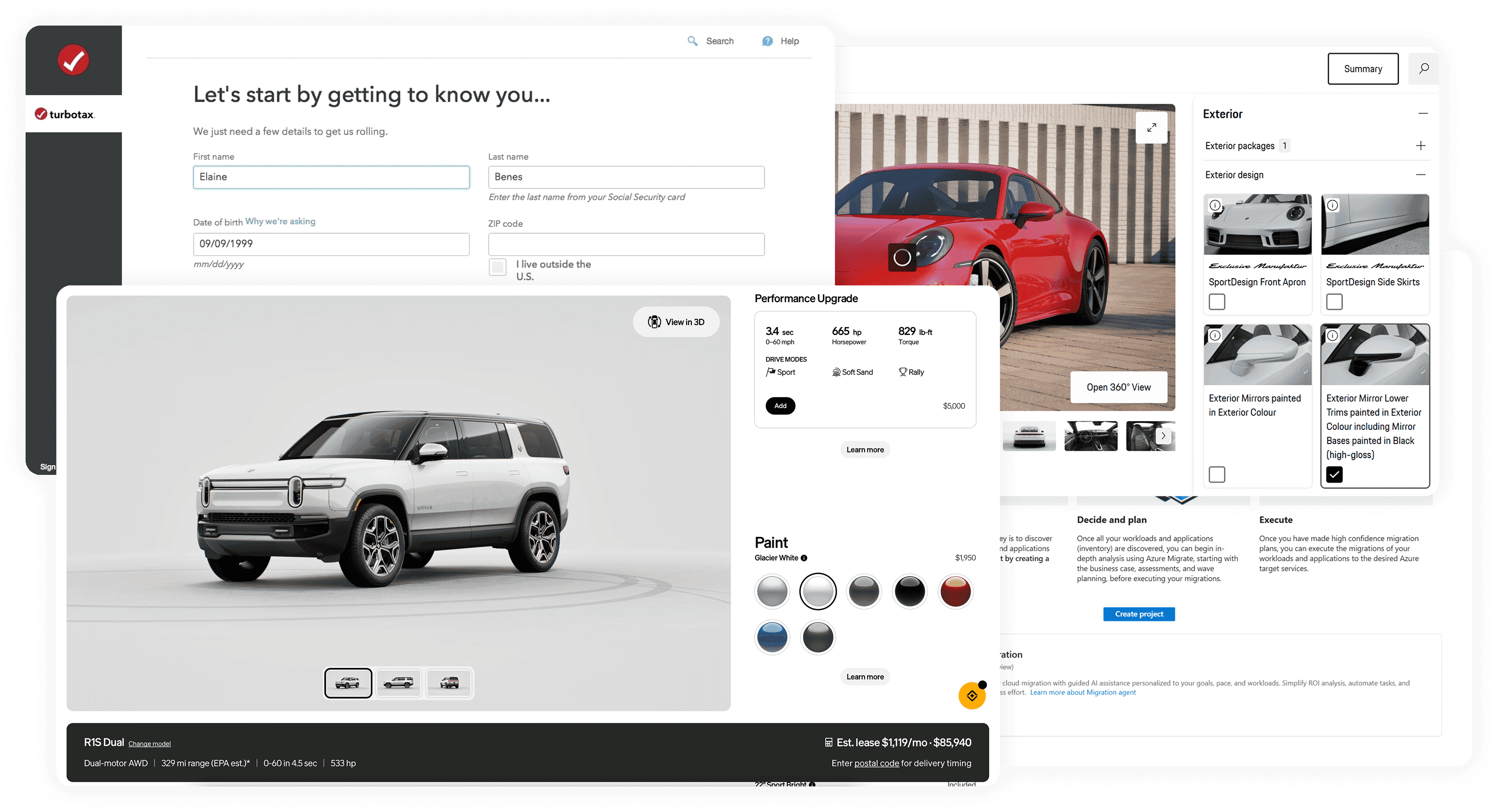
I explored ideas from different industries, tools with strong self-serve models, and configuration experiences that had simplified complex flows for non-expert users. Each option was reviewed with the team and aligned with our vision.
Defined key hypotheses
Based on user feedback and business requirements, we established 4 key hypotheses that became our foundation for the story and demo materials.
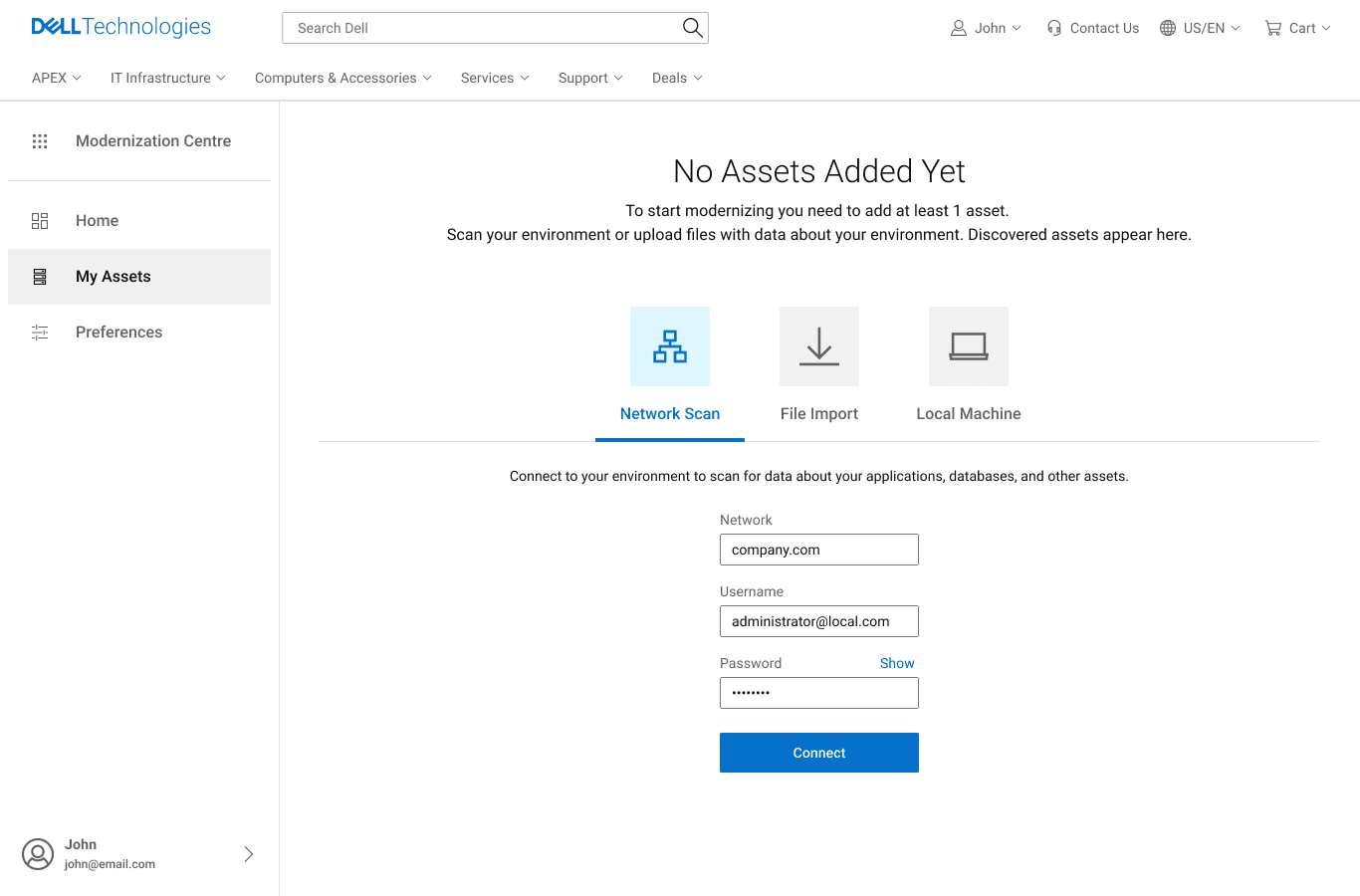
Easy environment scan set up by buyer
Buyers could add assets through network scanning, file import, or manual entry without specialist knowledge.
AI-powered recommendations
Automated recommendations replace manual calculations and suggest the best matching configuration.
Self-serve solution configuration
Buyer can configure the final solution selecting from the recommended options moving across the steps and connecting with sales representative at the end.
Guided customer assessment for sellers
Standardised customer assessment guided flow though the predefined questions and answers helping seller avoid missing important information.
Shaping Design Opportunities
I conducted daily workshops where my team and I were reviewing and iterating together using Figma canvas and prototypes, which helped us maintain the pace. After every workshop I summarised the feedback and worked on a new iteration to be ready to present it the next day.


An easy environment set up by buyers
✅
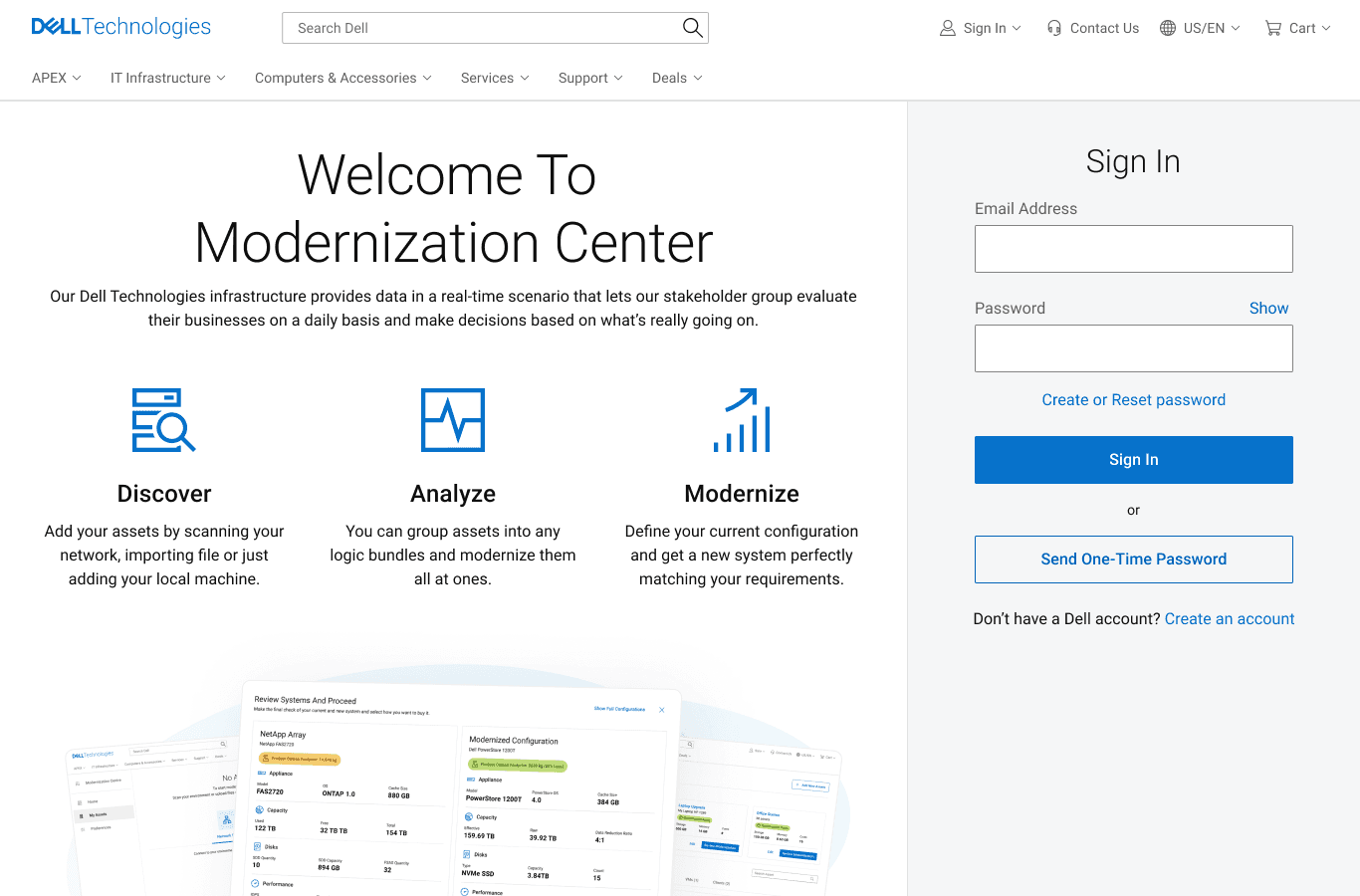
The most significant shift in the proposed experience was moving the start of the process from the seller to the buyer.
✅
Instead of a customer calling or emailing to begin an assessment, they could connect their environment directly by scanning their network, importing a file, or adding devices manually
✅
Eliminated the longest delay in the current process when buyers need to set up a collecting tool.
✅
Flow is embedded within the company's existing web platform.


AI-enabled configuration recommendations
✅
AI works naturally inside the experience, not as a separate workspace.
✅
Buyers select AI-generated modernization preferences based on their current environment and configuration history
✅
In the background, AI agents size the optimal configuration.
✅
Buyers can adjust preferences at any time to explore alternatives before proceeding.


Self-serve solution configuration experience
✅
All steps are unified into a single, coherent experience.
✅
Visual guidance connecting one step to the next.
✅
Users now have a reliable way to go back and adjust their choices without losing context.
✅
The product the user came to buy remaines visible and connected throughout the configuration journey.
Guided customer assessment for seller
✅
A knowledge-dependent process was replaced with a structured question sequence that allows even new seller to effectively collect customer data without mandatory trainings.
✅
All critical information is now being captured consistently.
✅
Eliminated the back-and-forth caused by missing or ambiguous data.
✅
Sellers can instantly size a new configuration using AI agents powered by sizing tool capabilities
Proof of concept was delivered as an interactive prototype and a video presentation
✅
Structured to guide an executive audience through the interactive and video experience without a presenter in the room.
✅
Prototype was built to be shared independently across teams before and after the presentation.
✅
Made the contrast with the current process visible and easy to understand for a non-design audience.
Impact
Leaders across the organisation endorsed the direction, agreeing that this is how the company needed to drive its modernisation selling process. The proof of concept initiated major collaboration across previously siloed organisations and set the foundation for a global modernisation of the seller flow.
50%
time will be invested in direct selling which is 35% more compared to current process.
25%
decrease in non-selling activities following implementation of the customer self-service flow.
direction by leaders across the company gave us the green light to begin development.
Executive feedback
❝
This is how we wholesale simplify and unify the end to end experience, ultimately pulling our teams out of the administration and into true value selling.
Senior Vice President, PreSales
❝
This is Fire...a Homerun in my opinion....We should put this in front of my Leaders then some of our
TSRs.
Senior Director, Inside Sales Management
Reflections
Keeping team discussions in the right direction
My role became as much facilitation as design, consistently redirecting to what the audience needed to understand.
Interpreting vague stakeholder feedback
I followed up after workshops with adjacent teams, gathered concrete recommendations, and brought specific proposals back rather than leaving questions open.
Integrate AI naturally
Do not reinvent the wheel or rush with new components to highlight AI's importance. Integrate AI capabilities inside the experience people already know. Familiarity lowers cognitive load and makes adoption easier.
Stakeholder navigation matters as much as design
The design and prototyping moved quickly, but the real work was navigating the stakeholder landscape. Understanding who needed to be consulted versus simply informed took time to figure out